Digital fashion is no longer a parallel universe of avatar skins and virtual showrooms; it has become a working method for producing the physical clothes that appear on runways and in stores. Designers now conceive garments in 3D software, iterate on virtual samples, and only then translate those files into patterns and fabric. The result is a design pipeline in which a garment may be fully refined before a single meter of material is cut — a shift that Tommy Hilfiger, as reported by Vogue's innovation editor Maghan McDowell in 2019, committed to by moving all of its design processes, from sketching through sampling and showrooming, to 3D by 2021.
The Digital Shift in Fashion Design
The transformation goes beyond adopting new software. As Kadine James and Joseph Fowler write for the World Economic Forum, fashion is undergoing a change "driven by a deeper cultural shift, one that challenges the very foundations of how we perceive identity, ownership and expression." In practical terms, that shift has moved design work off the sketchpad and into 3D environments where a garment exists first as a simulated object — complete with virtual fabric behavior, drape, and color — rather than as a paper drawing followed by a series of physical toiles.
The core promise of this method is validation before material. Digital fashion design, as the 3D software maker Style3D describes it, allows designers to create 3D garments, patterns, and visualizations digitally, eliminating the need for physical prototypes in the early stages. Rapid iteration on a virtual sample reduces waste and shortens the design cycle, because decisions that once required a sewn garment can now be made on screen. That efficiency argument is what has pushed digital tools from experimental studios into mainstream brand pipelines.
From Concept to Virtual Prototype: The Digital Workflow
What does digital-first design actually look like in practice? A peer-reviewed study of 3D dynamic fashion design, published in the journal indexed through PMC, documents the process concretely. Working in CLO3D, the researchers began with a base garment — a minimal sheath dress — as the default condition of a 3D dynamic garment. From there, they added a peplum and back details, transformed the dress silhouette, and increased its length, simulating five different styles from the single base. The same project, themed "Guilty plastics," showed color alterations and animating textile patterns applied to the virtual dress.
That example captures the essential advantage: the digital garment is a manipulable object rather than a fixed prototype. A designer can test a longer hem, a new back detail, or a different colorway in minutes, and compare the variants side by side before committing to any of them. The study frames this as the foundation for dynamic fashion design on online platforms, but the same logic applies inside a traditional design studio preparing a physical collection. Each virtual variant is a decision point that, in a purely physical workflow, would have required cutting and sewing another sample.
The Digital-to-Physical Fashion Design Workflow
The following sequence traces how a garment conceived digitally becomes a tangible piece, and where each stage departs from the traditional paper-and-toile method. It is the end-to-end model a reader can use to visualize how a collection is refined virtually before fabric is ever cut.
- Digital prototyping and concept. The designer creates a virtual garment in 3D software such as CLO3D, establishing a base garment with simulated fabric, fit, and drape — replacing the initial paper sketch and first physical toile.
- Virtual iteration and fitting. Silhouettes, lengths, details, and colors are altered and re-simulated on screen, as in the "Guilty plastics" study, where five styles were derived from one base dress. This stage speeds up design iterations and improves decision-making before physical production begins.
- Digital-to-physical pattern generation. The validated virtual design is translated into production patterns. This is why Tommy Hilfiger, per Vogue's reporting, trained not only its designers but also its patternmakers, fit technicians, product developers, and merchandisers in 3D digital design — the handoff from virtual garment to cutting pattern is a skilled step in its own right.
- Physical sample production. Patterns are cut and sewn into the physical garment. Under the digital-first model Tommy Hilfiger announced, the vast majority of the label's clothing would not be physically produced until it appeared on the runway or was sold, compressing physical production to the end of the process.
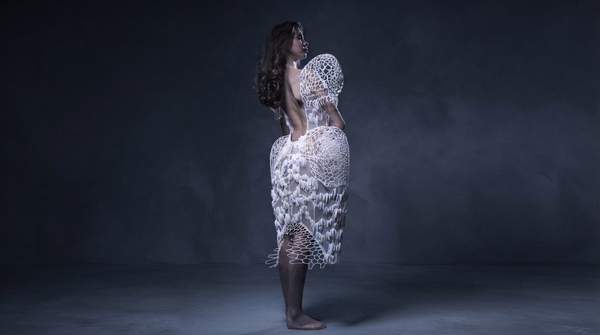
- Direct digital fabrication, where used. In a more experimental branch of the workflow, 3D models are used to create physical apparel and accessories directly through 3D printing. According to the 3D modeling resource UFO 3D, this usage remains limited — printed outfits can be seen on runways but not in stores — though the technology is evolving. The Tel Aviv-based designer Dani Peleg, for example, used clothes 3D modeling and printing to create her graduate collection "Liberty Leading the People," a follow-up collection called "The Birth of Venus," and a 3D printed dress for American Paralympic snowboarder Amy Purdy.
The decisive difference from the traditional method is where iteration happens. In a physical workflow, every refinement consumes fabric and labor; in the digital workflow, refinement is nearly free, and the expensive physical step happens once, late, and on a design that has already been validated.
Virtual Aesthetics in Real-World Collections
The influence runs deeper than process: aesthetics born in digital spaces, where design is not limited by physical constraints, are migrating into physical fashion. The clearest documented case is the exchange between luxury fashion and simulation games. Wikipedia's entry on digital fashion records that garments from brands including Chanel, Gucci, and Versace were copied and adapted into the aesthetics of games such as Animal Crossing: New Horizons and The Sims, with players recreating brand outfits during COVID-19 lockdowns. The traffic also flows the other way: in April 2019, Moschino collaborated with The Sims on a capsule collection that featured signature Jeremy Scott garments — a physical collection built directly on a game's visual language.
Research on virtual fashion points to the broader mechanism. An Atlantis Press paper on digital fashion describes virtual clothing as a fusion of digital technology and fabric material simulation, and notes that traditional runway presentations are evolving into digital showcases as the industry embraces digitalization across multiple dimensions. The same simulation capabilities that let a designer test a peplum on screen also make it possible to design garments with animated textile patterns, impossible physics, or hyper-saturated color — visual qualities native to screens. When those qualities are carried into physical collections, the physical garment inherits an aesthetic that originated in an environment with no gravity, no fabric cost, and no manufacturing constraint.
It is worth noting the boundary of this account: the evidence covers the general workflow and named examples such as Moschino, Tommy Hilfiger, and Dani Peleg, not an exhaustive catalog of every designer working digitally. Nor does it address the separate market for purely digital or NFT-based fashion, which follows a different logic entirely.
Embracing the Phygital Future of Fashion
Fashion designers and brands should integrate digital design tools and virtual aesthetic inspirations into their physical collection development to enhance creativity, efficiency, and sustainability. The evidence for this is no longer speculative: a major American label has already restructured its entire design organization around 3D, an academic study has demonstrated multi-variant design from a single virtual base garment, and physical collections have been built from game aesthetics and 3D printed models.
The measurable indicator to watch is increased adoption of 3D design software for initial collection development and the appearance of digitally-inspired aesthetics in mainstream physical fashion collections and runway shows. Tommy Hilfiger's stated 2021 deadline for all-digital design processes offered one concrete benchmark; the spread of similar commitments across other labels, and the visibility of simulation-native design traits on physical runways, will show whether the digital-to-physical workflow has become the industry's default rather than its frontier.
Sources
- What Is Digital Fashion Design and How Does It Revolutionize Fashion Creation? - Style3D Blog — Style3D Blog - Fashion Design Software for Creators
- 3D dynamic fashion design development using digital technology and its potential in online platforms - PMC
- Tommy Hilfiger switches to 100% digital design — Vogue
- Clothes 3D Modeling: 5 Ways It Changes the World of Fashion — Ufo 3d
- Digital fashion - Wikipedia — EN
- Atlantis PRESS