The most consequential partnerships between artists and fashion houses—Schiaparelli with Dalí in the 1930s, Keith Haring with Vivienne Westwood in the 1980s, and Takashi Murakami with Louis Vuitton in the 2000s—share a repeatable mechanism: an artist's signature visual language is embedded directly into garments and accessories, converting commercial products into scarce cultural artifacts that later command record auction prices and museum placements. Understanding that mechanism, rather than any single pairing, is what separates an influential collaboration from a licensed logo.
The Enduring Allure of Art-Fashion Collaborations
Art and fashion have long been intertwined, and that connection has produced a thriving market for luxury collectibles in which high-end items are valued for rarity and historical significance as much as aesthetics, as the art brokerage MyArtBroker notes. What began as occasional gestures between avant-garde circles has become, in the framing of Maddox Gallery's art market coverage, a dominant force across both runways and auction rooms since Schiaparelli's surrealist couture of the 1930s. The through-line across nearly a century is consistent: artists seek to expand their ideas beyond the gallery and reach new audiences and mediums, while brands acquire cultural capital that no advertising budget can buy. The result is a category of object that functions simultaneously as clothing, artwork, and investment-grade collectible.
Pioneering Surrealism: Schiaparelli and Dalí
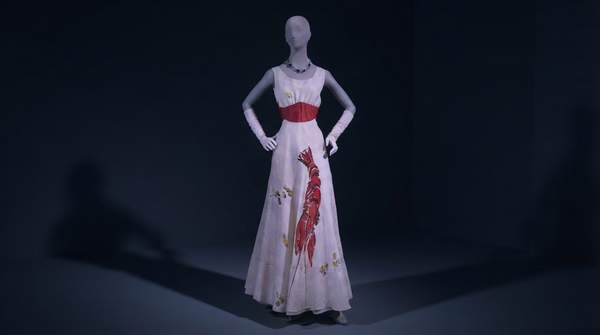
The template was set in the 1930s, when Elsa Schiaparelli collaborated with Salvador Dalí—and, per MyArtBroker's historical account, Jean Cocteau—to create wearable pieces that deliberately blurred the line between fashion and art. The Surrealists sought to challenge conventional norms and create a new reality through art, and that ambition translated into avant-garde designs with unusual shapes and textures. The most famous outcome was the 1937 Lobster dress, in which Dalí's crustacean motif was printed directly onto Schiaparelli's eveningwear. The significance of the pairing lies less in any commercial strategy than in its demonstration that fashion could communicate through images the way painting does—a proof of concept that Maddox Gallery credits as a cornerstone of modern haute couture and the ancestor of every collaboration that followed.
Pop Art's Runway Debut: Haring and Westwood
Half a century later, the collaboration migrated from couture salons to street culture. Vivienne Westwood and Malcolm McLaren's autumn/winter 1983 "Witches" collection—their final collaboration, as the Victoria and Albert Museum's collection record documents—followed a trip to America to meet Keith Haring, whose fluorescent, graffiti-inspired designs appeared across the pieces. The V&A credits the collection's eerie name to Haring's "magical, esoteric sign language," and situates it within early-1980s American hip-hop culture, then being popularized in Britain partly through McLaren's album Duck Rock, whose artwork Haring had drawn.
According to MyArtBroker's Isabella de Souza, Westwood and McLaren were the first to put Haring's art on the runway; signature pieces included a printed sheepskin jacket and a towelling shirt bearing a rubberised "Barking Dog" print. The pairing made Haring's imagery wearable, accessible, and pointedly commercial—consistent, as de Souza argues, with his conviction that art was a democratic medium.
Modern Iconography: Murakami and Louis Vuitton
The contemporary model industrialized the concept. Takashi Murakami's partnership with Louis Vuitton lasted roughly twelve years, with the Multicolore monogram designs proving especially popular, as Amna Rauf recounts for the Arts To Hearts Project. Where Schiaparelli produced singular couture and Westwood a single season, Louis Vuitton integrated Murakami's candy-colored reworking of its monogram across an accessories business at global scale, and the collaboration became one of the most influential examples of art and luxury fashion working together, paving the way for the artist partnerships that followed. Its afterlife proved the collectible thesis: when Louis Vuitton began reissuing Murakami designs in 2025, searches for vintage pieces surged and resale prices rose sharply—evidence, in Rauf's reading, that the bags had become symbols of a particular era of fashion and pop culture rather than merely old handbags.
Comparative Impact of Art-Fashion Collaborations
Setting the three partnerships side by side reveals the pattern: each embeds a recognizable artistic language into fashion, but the scale, intent, and market outcome shift decisively across eras—from one-off provocation, to street-level statement, to long-term brand strategy.
| Collaboration (Artist x Brand) | Era & Artistic Movement | Fashion Interpretation | Cultural & Market Impact |
|---|---|---|---|
| Elsa Schiaparelli x Salvador Dalí | 1930s; Surrealism, which challenged conventional norms to create a new reality | Avant-garde couture translating Dalí's imagery into wearable art, most famously the 1937 Lobster dress | Recognized as a pioneering art-fashion fusion and a cornerstone of modern haute couture that shaped later collaborations |
| Keith Haring x Vivienne Westwood (and Malcolm McLaren) | Early 1980s; Pop Art and graffiti-inspired street art, styled within hip-hop culture | Fluorescent, graffiti-inspired motifs on the autumn/winter 1983 "Witches" collection, including a printed sheepskin jacket and a "Barking Dog" towelling shirt | First to put Haring's art on the runway; helped make his imagery ubiquitous in pop culture and streetwear, fusing art with 1980s youth culture |
| Takashi Murakami x Louis Vuitton | 2000s; contemporary art and pop iconography applied at luxury scale | Murakami's Multicolore redesign of the Louis Vuitton monogram across handbags and accessories, sustained for roughly twelve years | A defining pop culture moment; the 2025 reissue triggered surging searches and sharply rising resale prices for vintage pieces |
Read across the rows, the comparison shows that the artifact-forming ingredients—an artist's signature motifs, a genuine fashion translation rather than a slapped-on logo, and cultural resonance with the moment—are constant, while the delivery mechanism scales from a single gown to a twelve-year product platform.
Beyond Branding: How Collaborations Create Collectible Value
The value created here exceeds conventional branding because the output is treated as art by the institutions that certify art's worth. Maddox Gallery points to the sharpest single data point: a Yayoi Kusama x Louis Vuitton Pumpkin bag sold for a record $151,200 in 2024, the most expensive Louis Vuitton handbag ever auctioned—a shift from "merch" to covetable artifact that, in its framing, marks a fundamental change in how creativity is valued and a new form of cultural capital. MyArtBroker adds the structural explanation: collaborations produce limited-edition works that may increase in value, sought after by collectors and investors alike precisely because of their rarity and historical significance.
Museum validation completes the loop—the V&A holds the Haring-Westwood jacket in its permanent collection—while the Murakami resale surge shows how a reissue can reprice an entire vintage category. The pattern is not exhaustive, and none of this constitutes investment advice, but the mechanism is well documented: artistic integration plus scarcity plus pop-culture resonance converts a commercial product into a collectible cultural artifact.
The Collectible Future of Art-Fashion
Strategic art-fashion collaborations are a proven mechanism for transforming commercial products into valuable cultural artifacts, driven by deep artistic integration and sustained market demand for scarcity. The evolution from Schiaparelli's one-off surrealist gowns to Murakami's twelve-year, reissue-capable brand platform shows the mechanism scaling without losing its core principle of artistic elevation. The trend's health can be tracked through a concrete indicator: continued high auction prices and museum acquisitions of collaborative fashion pieces, alongside the announcement of new long-term brand-artist partnerships—the Kusama record and the 2025 Murakami reissue being the most recent proof points.
Sources
- Where Art Meets Fashion: Exploring Collaborations Between Artists And Fashion Brands | MyArtBroker
- 7 Trailblazing Art and Fashion Collaborations That Transformed How We Talk About Art in Fashion — Maddox Gallery
- Jacket | Haring, Keith | Vivienne Westwood — Victoria and Albert Museum: Explore the Collections
- Keith Haring and Vivienne Westwood: An Iconic Collaboration | MyArtBroker
- 5 Art And Fashion Collaborations That Became Pop Culture Moments — Arts To Hearts Project