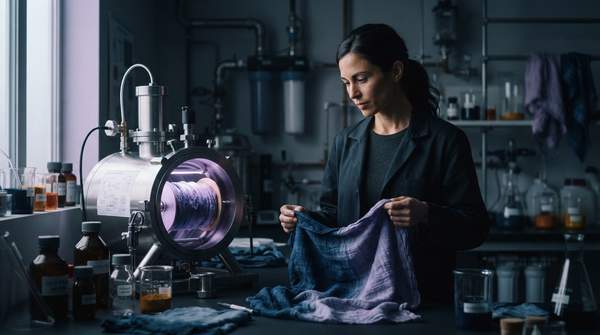
Chemical textile recycling works by dissolving fabric down to its molecular building blocks—monomers and oligomers—and then rebuilding those blocks into new fibers whose quality can approach that of virgin material. That molecular reset is precisely what distinguishes it from mechanical recycling, which physically shreds fabric and inevitably weakens the resulting fibers. According to the U.S. Government Accountability Office, chemical methods can produce fibers of similar quality to the originals, which is why the technology is watched closely by fashion brands seeking true textile-to-textile circularity rather than downcycling into insulation or stuffing. The catch: the process remains largely confined to laboratory and small-scale settings, blocked by sorting gaps, material complexity, and infrastructure that cannot yet handle high volumes.
Mechanical vs. Chemical Recycling: A Fundamental Difference in Quality
The two dominant recycling pathways differ at the most basic level: one is physical, the other molecular. Mechanical recycling, a well-established process dating back to the Industrial Revolution, deconstructs fibers through shredding, crushing, or melting before reprocessing them into yarn. The GAO notes that this physical handling produces weaker fibers and lower-quality textiles with limited uses, such as furniture stuffing or insulation. Fashion for Good, an industry innovation platform, describes mechanical recycling as widely used but fundamentally a physical breakdown of textile waste into smaller pieces.
Chemical recycling instead reduces textiles to their basic molecular building blocks using chemical solutions, then rebuilds them into fibers of similar quality. Because the required chemistry differs by material, conventional chemical methods are typically not effective for blends—though the GAO highlights novel enzymatic approaches in which certain enzymes can separate cotton and polyester at the molecular level, after which the fibers are reprocessed into usable material. Mechanical recycling, by contrast, works best for single-material textiles like 100 percent cotton and degrades further when applied to blends, which the GAO observes are present in most clothing.
The Chemical Recycling Pathway for Blended Textiles
The pathway from a discarded polycotton shirt to new fiber follows a defined sequence, and each stage determines whether the output is usable. The model below traces that progression as described in government, industry, and research sources.
| Stage | What happens | Why it matters |
|---|---|---|
| 1. Sorting and impurity removal | Waste is classified by material composition; non-recyclable impurities including colorants, buttons, and zippers are eliminated | Sorting is a prerequisite for recycling; accurate classification determines which chemical process can be applied |
| 2. Chemical conversion (depolymerization) | Chemical or enzymatic processes break polymers into monomers or oligomers; in polycotton blends, polyester can be fully depolymerized while cotton is preserved | This molecular separation is what mechanical recycling cannot achieve for blends |
| 3. Post-purification | Recovered monomers are purified through advanced separation stages, designed to reduce energy consumption and material loss | Purity determines whether the output can be repolymerized into textile-grade fiber |
| 4. Rebuilding new fibers | Purified monomers are repolymerized and spun into new textiles or polymers | Closes the materials loop with fiber quality comparable to virgin material |
The sequence is not optional: a researcher cited by Fabric Architecture Magazine, writing on textile-waste solutions, argues that widespread chemical recycling requires two pretreatment technologies—an accurate sorting technology that classifies individual materials, and a separation technology that eliminates non-recyclable impurities including colorants—before depolymerization can even begin. A recent research review of polycotton depolymerization similarly frames the problem as the integration of pretreatment strategies, selective chemical and enzymatic depolymerization workflows, and purification, noting that the heterogeneous composition of cotton/PET textiles poses a substantial challenge to efficient recycling.