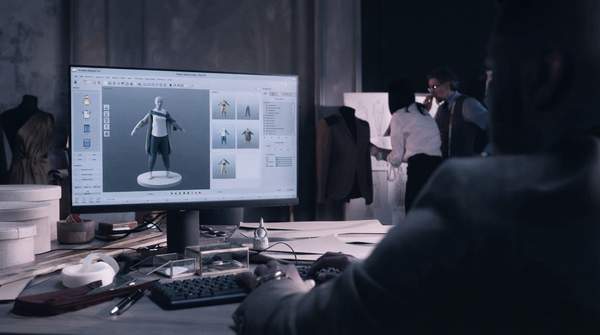
Artificial intelligence has entered the fashion design process at three distinct stages: trend forecasting, where algorithms mine social media and sales data for emerging signals; concept generation, where image models turn sketches and text prompts into photorealistic designs; and prototyping and marketing, where 3D virtual sampling and AI copywriting compress the path from idea to store. At each stage, the technology's function is specific and different, but the benefit follows a consistent logic—speed, reduced cost, and faster iteration—while the creative judgment remains human. The result is not a designer replaced by software but a workflow restructured around what machines do well and what people still do best.
Stage 1: Data-Driven Trend Forecasting
Traditionally, trend forecasting was slow, expensive, and inherently subjective, relying on analysts who could observe only a fraction of the visual and commercial information circulating in the culture. AI has changed that function at its root. AI-powered trend forecasting platforms process vast amounts of data, including social media posts, fashion blog content, online retail search queries, and historical sales figures, enabling them to identify emerging trend signals with unparalleled speed and scale, surpassing the capabilities of human analysts.
The output of this stage is not a finished design but a set of data-driven insights into consumer preferences and market shifts, delivered fast enough that brands can react to preferences in near real time. For designers, the practical benefit is predictive rather than reactive: instead of betting a collection on intuition, they begin the creative process with evidence about which silhouettes, colors, and moods are gaining momentum. Crucially, this reduces subjectivity without eliminating it—the data narrows the field of plausible directions, and the designer still decides which signals matter for the brand's identity.
Stage 2: Generative Design and Concept Creation
The second stage is where AI most visibly touches the act of design itself. Generative image tools—Wilson College of Textiles at North Carolina State University cites DALL-E, Midjourney, and Stable Diffusion as examples—process text or image inputs and transform them into illustrations or realistic images. The supply chain startup Cala introduced a tool in January 2023 that lets users describe design ideas in text or upload images, which the AI then renders as illustrations or photorealistic visuals; users can fine-tune those outputs before turning them into physical products.
The BBC documented this shift through a designer at ASOS who uses generative AI to transform sketches into photorealistic images, allowing quicker and smarter adjustments when an original sketch does not quite translate into the intended final style. The designer described the technology as something already emerging in the industry that could massively reduce waste, and expressed eagerness to bring it into her own workflow.
The benefit here is breadth of exploration. Because generating and evaluating dozens of visual concepts no longer carries the time and material cost of physical sampling, designers can test far more directions within the same timeline—experimenting with silhouettes, prints, and colorways, as Browzwear's design-software team puts it, without being limited by traditional design constraints. The stage's output is a curated set of concepts, not a random pile of images: the designer selects, refines, and carries the strongest ideas forward.